How to Tie the Goreum, and Common Mistakes
Which strip is which, which way the skirt wraps underneath, and the mistakes that make a jeogori sit badly.
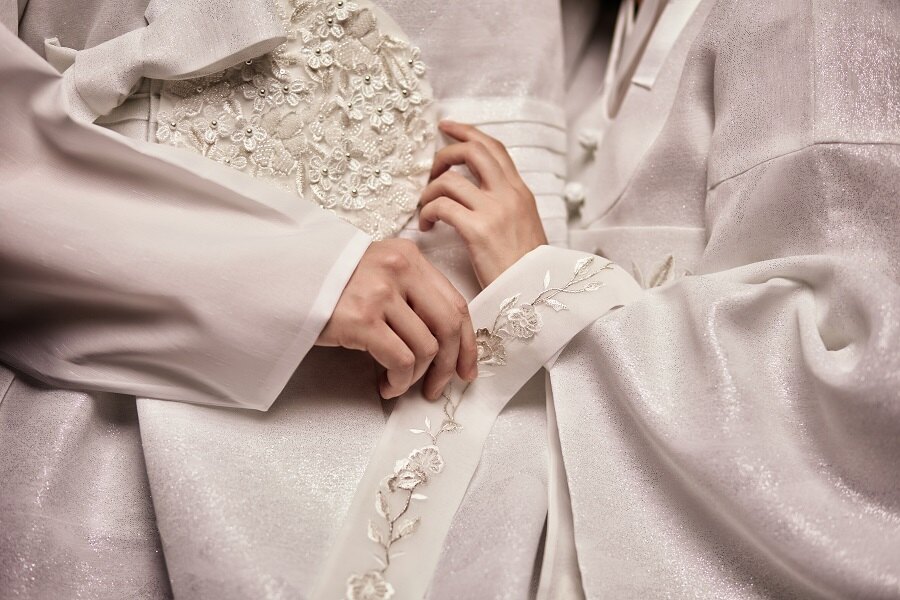
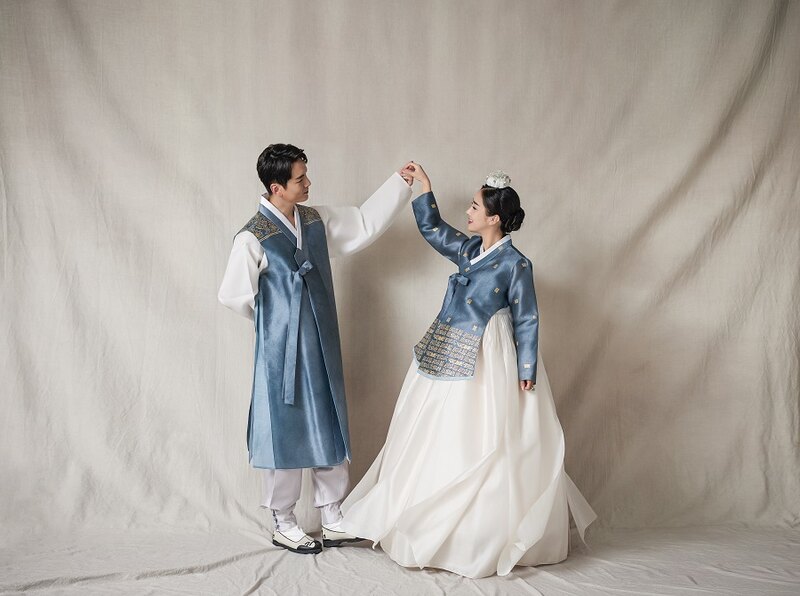
The goreum (고름) is the pair of cloth strips that hold a jeogori (저고리), the short upper jacket, or a durumagi (두루마기) closed. The garment has no buttons, so the strips are doing structural work rather than decoration. The Encyclopedia of Korean Culture dates the goreum to the late Goryeo period, when the jeogori shortened and the older belt fell away; in late Joseon, as women's jeogori grew very short, the strips became wider and longer. Most of the trouble beginners have happens before the knot, not during it.
The strips are long and short, not left and right
- The long strip hangs from the geotgit (겉깃), the outer collar half, the side that lies on top.
- The short strip hangs from the angit (안깃), the inner collar half, the side that tucks underneath.
Memorising them as left and right falls apart the moment you put on a man's jeogori or a durumagi (두루마기), the long overcoat. Compare lengths instead. A durumagi, and some jeogori, also carries a narrow sokgoreum (속고름), an inner tie for the hidden panel; fasten that first or the outer pair will not sit straight.
Settle the chima and its malgi first
The malgi (말기) is the banded waist at the top of a chima (치마), the wrapped skirt. The Korea Craft and Design Foundation's culture portal notes that this waistband was reworked into a vest-like bodice during the twentieth century, under the influence of school uniforms for girls.
- Sokbaji (속바지), the wide under-trousers, and a sokchima (속치마), the underskirt, go on first, then beoseon (버선) socks — bending down gets awkward once the skirt is on. Without the underskirt the outer skirt has no shape.
- The opening belongs at the back, and the outer panel wraps round to finish over the wearer's left — which is the viewer's right when you look at her from behind — overlapping the centre back by about 7-10 cm.
- Tie the straps above the chest and push the knot round to one side. A knot at the centre front shoves the jacket out.
Tying it
- Hold one strip in each hand and lay the short one across the long one.
- Take the short one under the long one and back up through, then pull it into a single half-knot.
- Fold one strip into a loop, called the go (고).
- Feed the other strip through that loop.
- Draw both together and settle the loop so it points toward the wearer's left.
The same portal publishes two versions of the last three steps: the short strip forms the loop and the long one passes through, or the lower long strip forms the loop and the short one wraps round and out. Either way you end with one loop and one hanging end, and pulling that end releases the whole thing.
The usual mistakes
- A shoelace bow with two loops. The traditional finish has one.
- Closing the jacket the wrong way. A jeogori today closes to the right.
- A gaping dongjeong (동정), the white band stitched along the collar edge. Draw it snug to the neck before you tie anything.
- Mismatched ends. The strands should fall to roughly the same length, with the loop clearing the seopseon (섶선), the diagonal front seam, by a little.
- Skipping the underskirt, then wondering why the silhouette went flat.
Where practice genuinely differs
The closing direction was not always fixed. One costume study argues that jwaim (좌임), the left-hand closure, disappeared after early Goguryeo and survives now only in yeomseup (염습), the dressing of the dead; Park Sun-hee of Sangmyung University points out that Goguryeo tomb murals show both directions side by side. Skirt overlap and pleat direction vary across surviving garments too. Gyeongbokgung's free-admission rules require both an upper and a lower garment and a jeogori with a wrapped collar, but state outright that the ties and the knotting method do not matter. The rest is muscle memory, and it arrives faster with a jacket on your shoulders.