Obangsaek: hanbok's five cardinal colours
What each of the five hanbok colours stands for, and how they are paired on a jeogori and chima.
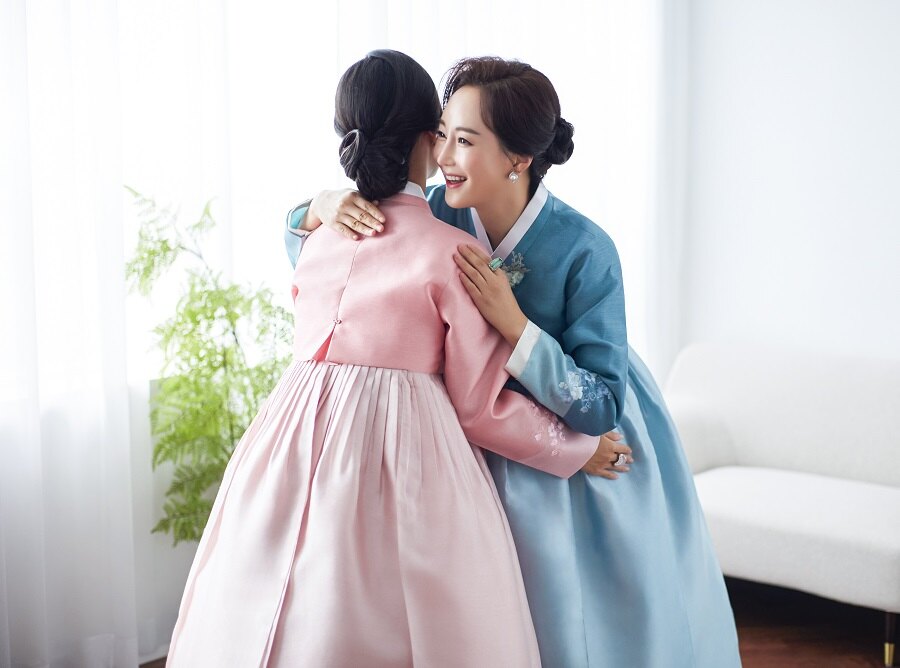
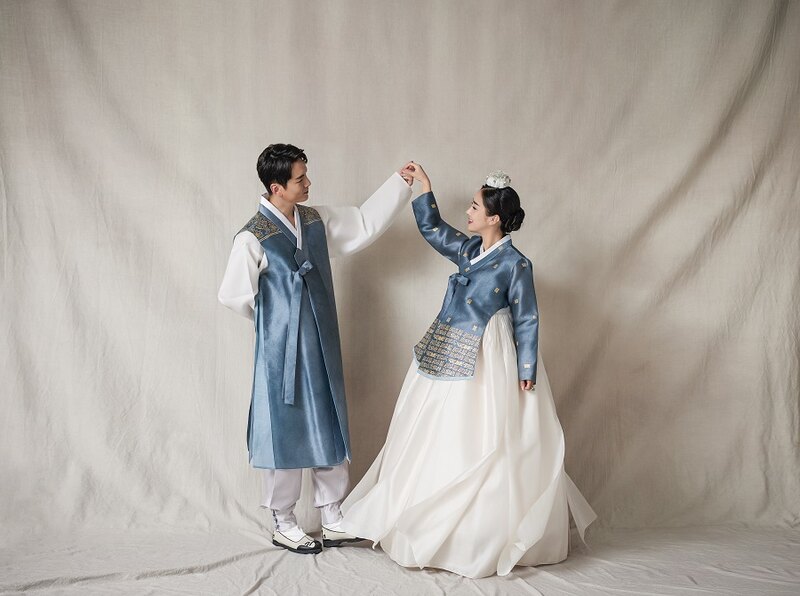
Hanbok colour is not only a matter of taste. Blue, red, yellow, white and black were each tied to a direction, a season and one of the five elements, and that system is called obangsaek (오방색), the five cardinal colours. Once you know where a colour sits, the pairing of jeogori (저고리), the short upper jacket, and chima (치마), the wrap skirt, reads much more clearly.
The five colours and their directions
Korean heritage sources set them out this way.
- Cheong (청), blue-green: east, spring, wood — where the sun rises and the trees stay green.
- Jeok (적), red: south, summer, fire — where the sun is strongest.
- Hwang (황), yellow: centre, late summer, earth — the middle of the ground, and light.
- Baek (백), white: west, autumn, metal — the colour read into metal.
- Heuk (흑), black: north, winter, water — the colour read into deep water.
Pure colours and mixed colours
These five are the ojeongsaek (오정색), the pure colours. Mixing them yields the ogansaek (오간색): noksaek (녹색) green, hongsaek (홍색) a light red, byeoksaek (벽색) pale blue, jasaek (자색) purple and yuhwangsaek (유황색) a dull sulphur yellow. Green sits between east (wood) and centre (earth), purple between south (fire) and north (water). Pure colours count as yang, mixed ones as yin. Adult hanbok rarely uses the pure hues straight — they are usually dropped a step or two in saturation.
What the colours did
Colour carried rank and wish at once. Yellow belonged to an emperor, so Joseon kings wore a red gollyongpo (곤룡포), the king's dragon robe, and took up yellow only after the Korean Empire was proclaimed in 1897. Official dress was graded by colour too — details shifted between periods, but broadly red for the highest ranks, blue below, green for the lowest. Red repelled misfortune, which is why a bride wore yeonji gonji (연지곤지), red dots on the cheeks and forehead. White was the everyday colour of ordinary people. A namsaek kkeutdong (남색 끝동), an indigo cuff at the sleeve end, is said to have marked a woman who had borne a son.
How the colours are combined
- Nogui-hongsang (녹의홍상): a yeondu (연두) light-green jeogori over a dahong (다홍) scarlet chima, a complementary pair worn by a new bride or on a celebration day.
- Hoejang (회장), contrast trim: banhoejang (반회장) puts a second colour on the collar, cuffs and ties; samhoejang (삼회장) adds the gyeonmagi (곁마기), the underarm panel.
- Saekdong (색동): sleeve cloth pieced from bands of colour, mostly the four pure colours red, blue, yellow and white, with mixed colours added or left out.
The working rule is to keep the large areas plain and the strong contrast small. That is why saekdong runs from shoulder to cuff while the body of the garment stays quiet. Age shifts the balance too: the young wear the sharper pairings, older wearers the lower saturations.
It varies by region and family
Wedding dress alone differed. Gaeseong used a light-green unlined wonsam (원삼), the ceremonial overrobe, with red edging and saekdong sleeves; Pyeongyang a green banhoejang jeogori with indigo cuffs; Jeollabuk-do a blue unlined wonsam with red collar and ties. The origin of saekdong is disputed as well — one account traces it to Goryeo monks, another to warding off harm by assembling the five elements. Trying a hanbok on is the quickest way to see how these pairings behave in motion.