How to Put On a Man's Hanbok
The order the layers go on, from socks to overcoat, and how each one is folded, wrapped and tied.
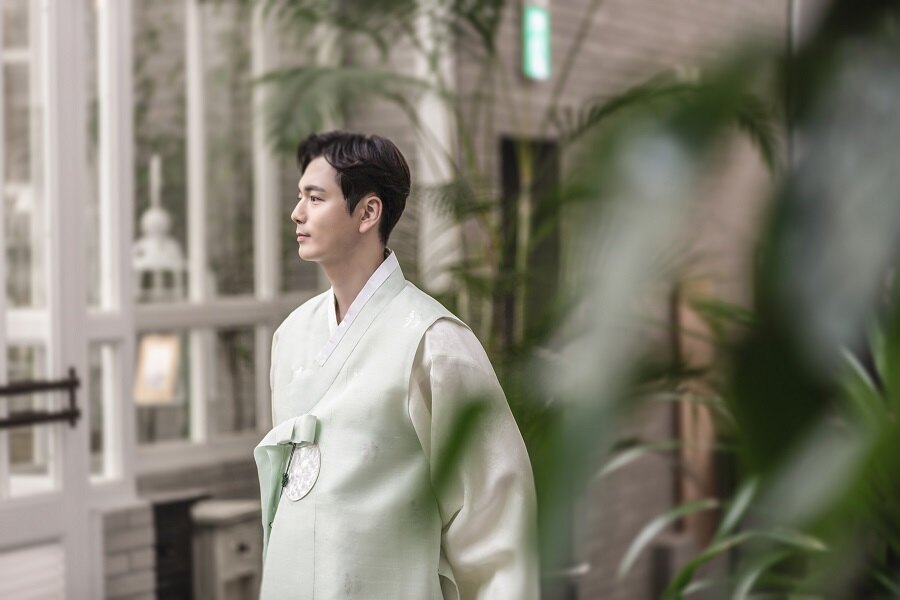
A man's hanbok is a stack of layers put on in a fixed order. Skip one, or reverse two, and the layer underneath shows at the cuff or the hem — the sequence does much of the work that cut and fit do in a Western suit.
The order of the layers
The Traditional Culture Portal, run by the Korea Craft and Design Foundation, illustrates two sequences rather than one:
- baji (바지), the trousers, and jeogori (저고리), the short upper jacket, then baeja (배자), a sleeveless overvest with matching collar bands, then durumagi (두루마기), the full-length outer coat
- baji and jeogori, then jokki (조끼), a waistcoat in traditional cloth, then magoja (마고자), a buttoned overjacket, then durumagi
Which middle layers you wear decides the sequence. Beoseon (버선), the shaped socks, go on first, before anything is tied at the ankle.
Trousers and ankle ties
Hanbok trousers are cut from a wide keunsapok (큰사폭) panel, a narrow jageunsapok (작은사폭), marupok (마루폭) leg panels and a waistband, with no vent and no pleats. There is no button or zip; you fold the surplus to fit.
- Put them on with the wide keunsapok on the right leg.
- Pull the loose waist tight to the right, then fold that gathered surplus back over to the left, so the pleat lies to the left at the centre front.
- Tie the heoritti (허리띠), the waist sash, and let the ends hang below the jacket.
- Set the trouser cuff against the inner ankle bone, fold the surplus outward, then wind the daenim (대님), the ankle tie, twice round and knot it.
The daenim knot usually faces inward at the ankle, though it is also tied facing out.
Jacket and ties
The jeogori opens down the front and wraps closed toward the right, so the left panel lies over the right. Settle the dongjeong (동정), the white collar band, against the neck; tie the inner goreum (고름) first, then the outer pair. Lay the short goreum from the right panel across the long one, pass it underneath and back up, then form a loop and draw it snug.
Vest and overjacket
Jokki and magoja both entered hanbok in the late nineteenth century. The jokki copied the Western waistcoat in traditional cloth, and since hanbok had no pockets it spread fast. The magoja has neither collar nor ties: it closes at the centre front with buttons, two of them on a man's, upper and lower, hooked into loops opposite.
Its origin is unsettled. It is commonly said to descend from the magwae (마괘), a Qing garment Heungseon Daewongun wore on his release from Baoding and return in 1885 (some reference works give 1887), but the National Folk Museum's dictionary notes an earlier Korean overjacket, the masangui (마상의), worn over the jeogori before that date. The same dictionary reckons the magoja was worn more in the centre and north of the peninsula than in the south, and notes photographs from the closing years of the Korean Empire showing it worn over a full-length coat, which suggests no single rule governed it.
The outer coat
The durumagi has no side or back vent. Its name is usually explained as meaning closed all the way round, though Kim Dong-uk traced it instead to a late-Goryeo Mongol word, hurumakchi. It has a straight collar with a dongjeong and ties, and a hem falling between the calf and the ankle. From King Gojong's reign it was worn regardless of rank, age or sex, and a man's outfit is still counted incomplete without it on a formal occasion. Put one on and the reason each layer closes the way it does stops being abstract.