Hanbok Care: Storage, Cleaning, Creases and Stains
What to do the day you wear it, how each fabric is washed, safe iron settings, and why hanbok is folded, not hung.
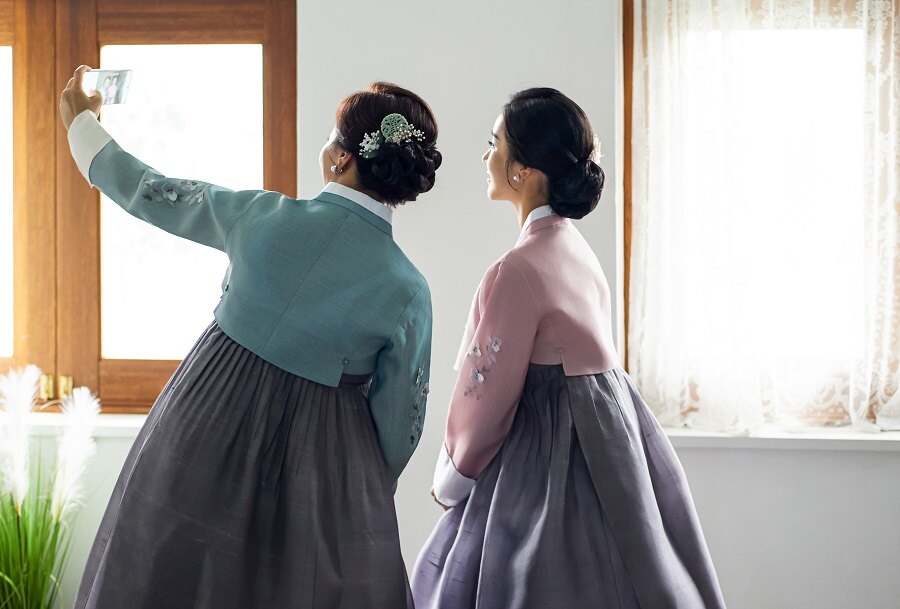
A hanbok is cut flat. The pattern pieces are straight panels, not shapes moulded to a body, and almost everything about caring for one follows from that. Left on a rail it sags at the shoulder and collar; folded flat it returns to shape. Most of the work happens the evening you take it off.
The evening you wear it
- Brush the dust off with a dry towel or a soft brush, starting where soil collects first: the collar, the cuffs, and the hem of the chima (치마), the wrap skirt.
- Air it in shade with moving air for a few hours before folding it away, so the damp of a day's wear leaves the cloth.
- The dongjeong (동정) is the narrow white band tacked along the collar of a jeogori (저고리), the short upper jacket. It is meant to be unpicked and replaced when it greys, so the whole garment need not be washed.
Stains
Deal with a mark where it happens. Given time it sinks into the fibre and oxidises. Slide a dry towel underneath, then lift the stain into that towel by dabbing from the outside of the mark inwards with a cloth carrying a little neutral detergent, or a cotton bud dampened with water. Rubbing mats the fibres and spreads the ring. The damp-bud method is for cotton, bast fibres and synthetics. On real silk, water rings the cloth whatever the size of the mark: blot with a dry cloth only, and leave the rest to a specialist cleaner.
Washing, fabric by fabric
- Real silk is not washed in water; it goes to a dry cleaner. Tell the cleaner if the garment carries gold leaf (금박) or gold-thread embroidery — solvent lifts the leaf straight off, so those pieces are better spot-cleaned than cleaned whole. Repeated cleaning also dulls the colour and stresses the fine seams.
- Cotton, ramie (모시, mosi) and hemp (삼베, sambe) can be hand-washed in lukewarm water with a neutral detergent, pressed rather than rubbed, and never wrung out.
- Polyester blends, common in rental and everyday hanbok, hand-wash at 30–40°C and dry in shade.
Creases and the iron
Press the lining first, then the outer cloth. Korean care guides give the order for a jeogori as back panel, sleeve backs, front panels, sleeve fronts, collar, then the goreum (고름), the pair of ties. On a chima, press the hem and the front edge band from the lining side, then work up the panels from the bottom, then the waistband. Do not press the pleats flat. Temperature follows the fibre: synthetics under 120°C, wool 120–130°C, silk about 130°C, ramie and hemp 160–170°C, cotton 160–180°C. Lay a thin cotton press cloth over embroidery or gold leaf, and never spray water on silk, which rings.
Storage
Fold it and lay it flat. A sheet of hanji (한지), Korean mulberry paper, or acid-free tissue at each fold softens the crease line. For a jeogori, lay the ties along the body panel and fold the sleeves inward at the armhole line, keeping the collar and dongjeong uncreased. For a chima, fold along the panel seams, then fold it in half across its length. Guides differ on the number of folds — four widths in some, thirds twice in others. Use a breathable cloth cover rather than plastic, and keep it dark, since silk is reckoned the most light-sensitive of the common textile fibres. Steady humidity matters too: swings make fibres swell and shrink out of shape, and damp brings mould and clothes moths.
Households differ. A hanbok in regular use is often hung for short spells, the jeogori by the armholes so the sleeves fall straight, the chima by tying a cord around its eokkaeheori (어깨허리), the shoulder-strap waistband. Airing the wardrobe in shade on a clear dry day after the summer rains, garments turned inside out, is an old habit that still works. Moth repellent is disputed: Korean care guides say use it and change it often, while some hanbok makers advise keeping it away from silk. Either way, it should not touch the cloth.
Most of this makes plain sense after a day in one, once you have felt where a hanbok creases and where it does not.